Reading Anchor
OpenStax Astronomy 2e, Chapter 1.4 on astronomical scale and Chapter 19.2 on stellar parallax and distances. The local textbook reference is stored at references/openstax-astronomy-2e.pdf. These notes use the textbook for scope and terminology while presenting original explanations and examples.
Lecture Arc
Astronomy studies objects too far away to touch. Distance measurement therefore relies on geometric baselines, calibrated relationships, and careful uncertainty accounting.
The lecture should begin by asking students what can be observed directly. Only after that should the explanatory model be introduced. This helps students distinguish evidence from interpretation, a distinction that becomes essential when the course moves from the night sky to stars, galaxies, and cosmology.
Terms Developed in Context
These terms form a connected reasoning system for the lecture. Each entry extends the concise slide panel by showing how the term is used, what it is linked to observationally or mathematically, and where its interpretation can fail.
- astronomical unit
A distance unit defined as exactly 149,597,870,700 metres, close to Earth's average distance from the Sun. It puts solar-system distances on a manageable numerical scale. The AU supplies the baseline for annual stellar parallax and links planetary distances to Kepler's laws.
In context: Expressing planetary distances in AU reveals orbital scale ratios directly. The modern AU is fixed by definition rather than continually remeasured from Earth's changing orbit. Boundary: It is a unit, not Earth's instantaneous Sun distance, which varies along Earth's orbit.
- light-year
The distance light travels in vacuum during one Julian year. It connects cosmic distance to light-travel time and therefore to how far into the past we observe. One parsec is about 3.26 light-years; both are distance units used beyond the solar system.
In context: A star 10 light-years away is seen through light that has traveled for about 10 years. This does not mean the star itself is 10 years old. Boundary: Despite the word year, it measures distance, not duration.
- parsec
The distance at which one astronomical unit subtends a parallax angle of one arcsecond. It ties a widely used stellar distance unit directly to a measurable geometric angle. Distance in parsecs is the reciprocal of annual parallax in arcseconds for the standard small-angle geometry.
In context: A parsec is about \(3.086\times10^{16}\) m or 3.26 ly. Catalog inference at low signal-to-noise often uses probability models rather than simply inverting a noisy parallax. Boundary: The reciprocal formula becomes statistically delicate when parallax uncertainty is comparable to the measured parallax.
- parallax
An apparent shift in an object's direction caused by observing it from separated positions. Annual stellar parallax provides a direct geometric rung of the cosmic distance ladder. A larger baseline increases the shift, while a larger distance decreases it.
In context: Earth's orbit provides observations six months apart with a two-AU separation, while the conventional parallax angle uses a one-AU radius. Nearby stars show larger parallaxes than distant stars. Boundary: Parallax is an angular effect and must be separated from proper motion and measurement systematics.
- baseline
The known separation between observing positions used in triangulation. A longer baseline produces a larger parallax angle for the same target and improves geometric leverage. Baseline, angular shift, and distance form the parallax triangle.
In context: Classroom parallax may use the distance between two eye positions; stellar parallax uses Earth's orbit. The baseline must be stated consistently with whether the measured angle is a half-shift or full shift. Boundary: Increasing baseline does not remove errors in pointing, reference-star calibration, or source motion.
- standard candle
An object or relation whose intrinsic luminosity can be estimated, allowing distance to be inferred from observed flux. It extends distance measurement far beyond the direct reach of trigonometric parallax. It uses the inverse-square law and must be calibrated by nearer distance indicators.
In context: Cepheid variables and Type Ia supernovae are standardizable rather than literally identical candles. Their reliability depends on overlapping distance-ladder rungs. Boundary: Standard candles are not perfectly identical; extinction, metallicity, and calibration scatter can bias the inferred distance.
- order of magnitude
A scale expressed by the nearest power of ten. It allows rapid comparisons and exposes results that are physically implausible before detailed calculation. Logarithmic scales, scientific notation, and ratio reasoning all use orders of magnitude.
In context: Earth-Sun distance is about \(10^{11}\) m, while the nearest-star distance is about \(10^{16}\) m, a five-order-of-magnitude gap. The method is a reasonableness check, not a claim of exact equality. Boundary: It deliberately suppresses factors of a few and should not replace precision when precision matters.
Evidence Table
| # | Evidence or observation | How students should interrogate it |
|---|---|---|
| 1 | Nearby stars shift position slightly against distant background stars over Earth's orbit. | What measurement, image, spectrum, or sky observation would support this? |
| 2 | Light travel time gives a physical meaning to distance. | What measurement, image, spectrum, or sky observation would support this? |
| 3 | Different distance methods overlap, creating a distance ladder. | What measurement, image, spectrum, or sky observation would support this? |
Model Development
The model for this lecture has three linked parts:
- Trigonometric parallax is direct geometry for nearby stars.
- A parsec is defined by a parallax angle of one arcsecond.
- Order-of-magnitude checks catch impossible claims before detailed calculation.
The instructor should emphasize where the model is a simplification. Introductory astronomy often works by adopting a useful first model, identifying its assumptions, and then refining it when new evidence demands more detail.
Quantitative Reasoning
This equation or proportionality is not just a formula to memorize. It is a compact statement of a physical or geometric relationship. A strong student solution defines each symbol, states the unit system, identifies the assumptions, and interprets the result in words.
Worked Example
- A star with parallax 0.050 arcsec has distance 20 pc.
- Using 1 pc = 3.26 ly, this is about 65 ly.
- If the parallax uncertainty is 0.005 arcsec, the fractional uncertainty is about 10 percent.
After completing the calculation, students should ask whether the result is plausible. A numerical answer without a reasonableness check is not yet a scientific conclusion.
Visual Interpretation
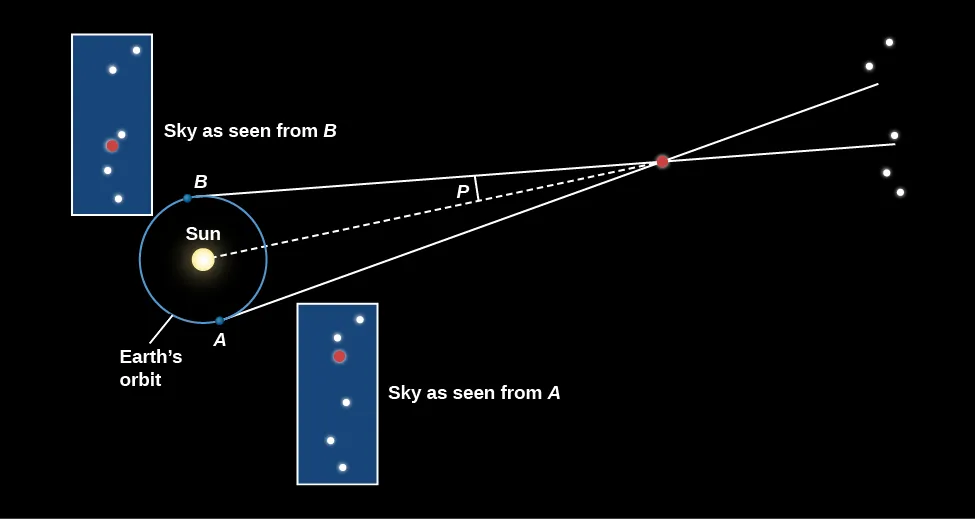
Parallax turns a measured angular shift across Earth's orbital baseline into an inferred stellar distance. Credit: OpenStax Astronomy 2e, Fig. 19.6, CC BY-NC-SA 4.0.
Misconception and Boundary Condition
The correction should not be presented as a slogan. It should be tied to the evidence and model from this lecture. Students should practice saying what would be different if the misconception were true.
Active Learning Plan
Students rank Earth-Moon, Sun-Earth, nearest star, Milky Way diameter, and observable-universe scale on a logarithmic axis.
A suggested timing is 2 minutes individual prediction, 3 minutes peer comparison, and 3 minutes whole-class synthesis. The point is to make students commit to a model before seeing the instructor's full explanation.
Lab or Observing Connection
Lab 03 uses a classroom parallax baseline and a scale-model activity.
Students should see the lab as a continuation of lecture reasoning. The lab does not merely demonstrate a concept; it asks students to collect, interpret, or critique evidence with uncertainty.
Synthesis and Study Questions
Every later physical claim depends on distance: luminosity, size, mass, and age all inherit distance uncertainty.
- What was the central observation or evidence pattern?
- What model explains it, and what assumptions does the model make?
- Where did quantitative reasoning constrain the claim?
- What uncertainty, limitation, or misconception remains important?
References
- OpenStax, Astronomy 2e: OpenStax Astronomy 2e, Chapter 1.4 on astronomical scale and Chapter 19.2 on stellar parallax and distances.
- Course reference log:
../reference-log.md.