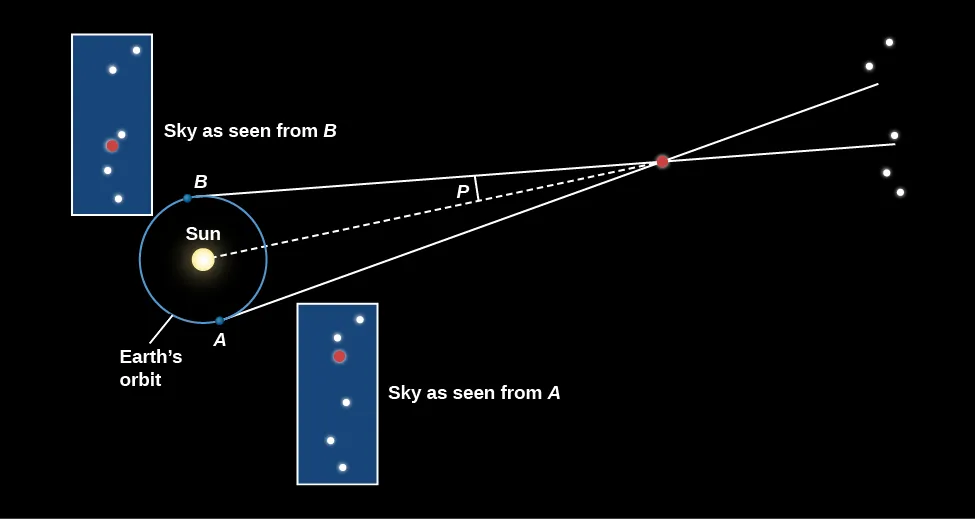
astronomical unit
Definition: A distance unit defined as exactly 149,597,870,700 metres, close to Earth's average distance from the Sun.
Why it matters here: It puts solar-system distances on a manageable numerical scale.
Relationships: The AU supplies the baseline for annual stellar parallax and links planetary distances to Kepler's laws.
Boundary or common confusion: It is a unit, not Earth's instantaneous Sun distance, which varies along Earth's orbit.
light-year
Definition: The distance light travels in vacuum during one Julian year.
Why it matters here: It connects cosmic distance to light-travel time and therefore to how far into the past we observe.
Relationships: One parsec is about 3.26 light-years; both are distance units used beyond the solar system.
Boundary or common confusion: Despite the word year, it measures distance, not duration.
parsec
Definition: The distance at which one astronomical unit subtends a parallax angle of one arcsecond.
Why it matters here: It ties a widely used stellar distance unit directly to a measurable geometric angle.
Relationships: Distance in parsecs is the reciprocal of annual parallax in arcseconds for the standard small-angle geometry.
Boundary or common confusion: The reciprocal formula becomes statistically delicate when parallax uncertainty is comparable to the measured parallax.
\[ d({\rm pc})=\frac{1}{p({\rm arcsec})} \]
parallax
Definition: An apparent shift in an object's direction caused by observing it from separated positions.
Why it matters here: Annual stellar parallax provides a direct geometric rung of the cosmic distance ladder.
Relationships: A larger baseline increases the shift, while a larger distance decreases it.
Boundary or common confusion: Parallax is an angular effect and must be separated from proper motion and measurement systematics.
baseline
Definition: The known separation between observing positions used in triangulation.
Why it matters here: A longer baseline produces a larger parallax angle for the same target and improves geometric leverage.
Relationships: Baseline, angular shift, and distance form the parallax triangle.
Boundary or common confusion: Increasing baseline does not remove errors in pointing, reference-star calibration, or source motion.
standard candle
Definition: An object or relation whose intrinsic luminosity can be estimated, allowing distance to be inferred from observed flux.
Why it matters here: It extends distance measurement far beyond the direct reach of trigonometric parallax.
Relationships: It uses the inverse-square law and must be calibrated by nearer distance indicators.
Boundary or common confusion: Standard candles are not perfectly identical; extinction, metallicity, and calibration scatter can bias the inferred distance.
\[ F=\frac{L}{4\pi d^2} \]
order of magnitude
Definition: A scale expressed by the nearest power of ten.
Why it matters here: It allows rapid comparisons and exposes results that are physically implausible before detailed calculation.
Relationships: Logarithmic scales, scientific notation, and ratio reasoning all use orders of magnitude.
Boundary or common confusion: It deliberately suppresses factors of a few and should not replace precision when precision matters.