Reading Anchor
OpenStax Astronomy 2e, Chapter 3.1-3.4 on Kepler's laws, Newton's laws, orbital motion, and tides. The local textbook reference is stored at references/openstax-astronomy-2e.pdf. These notes use the textbook for scope and terminology while presenting original explanations and examples.
Lecture Arc
Planets do not move randomly: they sweep out repeatable paths that reveal how gravity organizes motion from moons to galaxies.
The lecture should begin by asking students what can be observed directly. Only after that should the explanatory model be introduced. This helps students distinguish evidence from interpretation, a distinction that becomes essential when the course moves from the night sky to stars, galaxies, and cosmology.
Terms Developed in Context
These terms form a connected reasoning system for the lecture. Each entry extends the concise slide panel by showing how the term is used, what it is linked to observationally or mathematically, and where its interpretation can fail.
- ellipse
A closed curve for which the sum of distances to two fixed foci is constant. Bound two-body orbits are ellipses in the Newtonian approximation. The central mass lies at one focus; semi-major axis sets orbital scale and eccentricity sets shape.
In context: A circle is the special case with coincident foci and zero eccentricity. The geometric center of an ellipse is not generally the location of the attracting body. Boundary: Real multi-body orbits are perturbed and need not remain perfect fixed ellipses.
- semi-major axis
Half the longest diameter of an ellipse. For a bound orbit it is the characteristic size that enters Kepler's third law and the orbital energy. Orbital period grows as \(a^{3/2}\) for bodies orbiting the same dominant mass.
In context: Periapsis and apoapsis distances are \(a(1-e)\) and \(a(1+e)\). Thus the same semi-major axis can accompany different distance variations when eccentricity differs. Boundary: It is not the instantaneous distance from the orbiting body to the focus except for a circular orbit.
- period
The time required for a repeating motion to complete one cycle. Orbital period is directly observable and constrains system mass when paired with orbital size. Kepler's third law connects period to semi-major axis and total gravitating mass.
In context: For planetary dynamics the sidereal orbital period is usually intended. A synodic period measures recurrence as seen from another moving body and can differ substantially. Boundary: Different periods can be defined relative to the stars, the Sun, or repeating alignments.
- eccentricity
A dimensionless measure of how much an orbit departs from a circle. It controls the contrast between nearest and farthest orbital distances and the associated speed changes. Bound ellipses have \(0\le e<1\); \(e=0\) is circular.
In context: Eccentricity describes shape but not size or orientation. Seasons on Earth are dominated by axial tilt, not Earth's small orbital eccentricity. Boundary: A diagram can exaggerate eccentricity, and Earth's orbit is much closer to circular than many textbook sketches suggest.
- center of mass
The mass-weighted average position of all matter in a system. Two gravitating bodies both orbit their common center of mass rather than one remaining perfectly fixed. Its location obeys \(m_1r_1=m_2r_2\) for two bodies along their separation line.
In context: The Sun's reflex motion around the solar-system barycenter underlies radial-velocity planet detection. Center-of-mass reasoning also prevents treating the smaller body's effect as exactly zero. Boundary: It can lie inside one body, between bodies, or even outside both; it is not necessarily a material point.
- escape velocity
The minimum launch speed needed to reach arbitrarily large distance with zero speed remaining, neglecting later propulsion and drag. It connects a body's mass and radius to atmospheric retention and spacecraft energetics. For a spherical body, \(v_{\rm esc}=\sqrt{2GM/R}\).
In context: Escape speed depends on gravitational potential, not projectile mass. A body can escape with lower instantaneous speed if engines add energy throughout the trajectory. Boundary: It is not the speed needed to remain in orbit, and real launches face atmosphere, rotation, and powered trajectories.
- tide
A differential gravitational effect caused by variation in gravitational acceleration across an extended body. Tides deform oceans and solid bodies, exchange angular momentum, heat moons, and can disrupt objects. Tidal strength rises strongly at small separation, approximately as \(M/r^3\) for a distant perturber.
In context: The near and far sides of Earth both experience ocean bulges in the idealized model because acceleration relative to Earth's center differs on both sides. Local coastlines and ocean dynamics then shape observed tidal heights. Boundary: A tide is not simply the total gravitational pull; uniform acceleration of the whole body does not create stretching.
Evidence Table
| # | Evidence or observation | How students should interrogate it |
|---|---|---|
| 1 | Planet positions repeat with periods related to orbital size. | What measurement, image, spectrum, or sky observation would support this? |
| 2 | Moons, planets, asteroids, and spacecraft all follow the same gravitational principles. | What measurement, image, spectrum, or sky observation would support this? |
| 3 | Tidal effects depend on differences in gravitational pull across an extended body. | What measurement, image, spectrum, or sky observation would support this? |
Model Development
The model for this lecture has three linked parts:
- Kepler's laws summarize orbital patterns; Newton's law explains why they occur.
- An orbit is free fall with enough sideways motion to continually miss the central body.
- The two-body model is powerful but approximate; real systems include perturbations.
The instructor should emphasize where the model is a simplification. Introductory astronomy often works by adopting a useful first model, identifying its assumptions, and then refining it when new evidence demands more detail.
Quantitative Reasoning
This equation or proportionality is not just a formula to memorize. It is a compact statement of a physical or geometric relationship. A strong student solution defines each symbol, states the unit system, identifies the assumptions, and interprets the result in words.
Worked Example
- An asteroid with semi-major axis 4 AU has P^2 = 64, so P = 8 years.
- The same proportionality does not apply unchanged around a different central mass.
- A unit check clarifies which version of Kepler's law is being used.
After completing the calculation, students should ask whether the result is plausible. A numerical answer without a reasonableness check is not yet a scientific conclusion.
Visual Interpretation
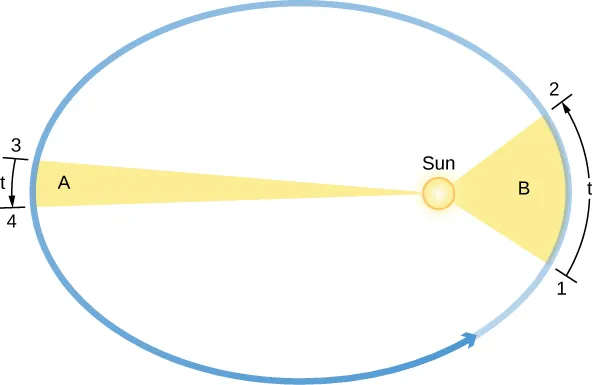
Equal time intervals sweep equal areas, so orbital speed changes along an ellipse. Credit: OpenStax Astronomy 2e, Fig. 3.5, CC BY-NC-SA 4.0.
Misconception and Boundary Condition
The correction should not be presented as a slogan. It should be tied to the evidence and model from this lecture. Students should practice saying what would be different if the misconception were true.
Active Learning Plan
Students compare two orbits with different semi-major axes and eccentricities and predict period, speed changes, and observational consequences.
A suggested timing is 2 minutes individual prediction, 3 minutes peer comparison, and 3 minutes whole-class synthesis. The point is to make students commit to a model before seeing the instructor's full explanation.
Lab or Observing Connection
The orbital analysis activity uses simple plots of period versus semi-major axis.
Students should see the lab as a continuation of lecture reasoning. The lab does not merely demonstrate a concept; it asks students to collect, interpret, or critique evidence with uncertainty.
Synthesis and Study Questions
Gravity turns observation into prediction: if the model is right, positions, speeds, and periods are linked quantitatively.
- What was the central observation or evidence pattern?
- What model explains it, and what assumptions does the model make?
- Where did quantitative reasoning constrain the claim?
- What uncertainty, limitation, or misconception remains important?
References
- OpenStax, Astronomy 2e: OpenStax Astronomy 2e, Chapter 3.1-3.4 on Kepler's laws, Newton's laws, orbital motion, and tides.
- Course reference log:
../reference-log.md.