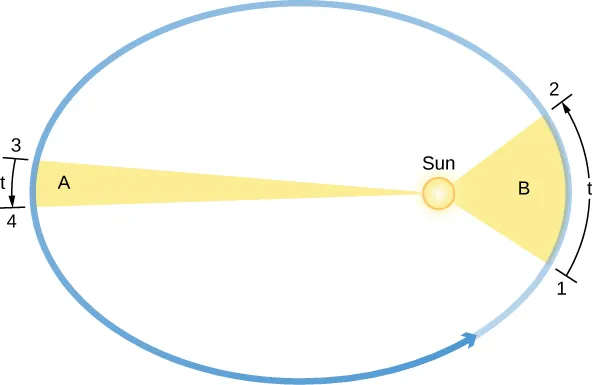
ellipse
Definition: A closed curve for which the sum of distances to two fixed foci is constant.
Why it matters here: Bound two-body orbits are ellipses in the Newtonian approximation.
Relationships: The central mass lies at one focus; semi-major axis sets orbital scale and eccentricity sets shape.
Boundary or common confusion: Real multi-body orbits are perturbed and need not remain perfect fixed ellipses.
semi-major axis
Definition: Half the longest diameter of an ellipse.
Why it matters here: For a bound orbit it is the characteristic size that enters Kepler's third law and the orbital energy.
Relationships: Orbital period grows as \(a^{3/2}\) for bodies orbiting the same dominant mass.
Boundary or common confusion: It is not the instantaneous distance from the orbiting body to the focus except for a circular orbit.
\[ P^2\propto a^3 \]
period
Definition: The time required for a repeating motion to complete one cycle.
Why it matters here: Orbital period is directly observable and constrains system mass when paired with orbital size.
Relationships: Kepler's third law connects period to semi-major axis and total gravitating mass.
Boundary or common confusion: Different periods can be defined relative to the stars, the Sun, or repeating alignments.
eccentricity
Definition: A dimensionless measure of how much an orbit departs from a circle.
Why it matters here: It controls the contrast between nearest and farthest orbital distances and the associated speed changes.
Relationships: Bound ellipses have \(0\le e<1\); \(e=0\) is circular.
Boundary or common confusion: A diagram can exaggerate eccentricity, and Earth's orbit is much closer to circular than many textbook sketches suggest.
center of mass
Definition: The mass-weighted average position of all matter in a system.
Why it matters here: Two gravitating bodies both orbit their common center of mass rather than one remaining perfectly fixed.
Relationships: Its location obeys \(m_1r_1=m_2r_2\) for two bodies along their separation line.
Boundary or common confusion: It can lie inside one body, between bodies, or even outside both; it is not necessarily a material point.
\[ m_1r_1=m_2r_2 \]
escape velocity
Definition: The minimum launch speed needed to reach arbitrarily large distance with zero speed remaining, neglecting later propulsion and drag.
Why it matters here: It connects a body's mass and radius to atmospheric retention and spacecraft energetics.
Relationships: For a spherical body, \(v_{\rm esc}=\sqrt{2GM/R}\).
Boundary or common confusion: It is not the speed needed to remain in orbit, and real launches face atmosphere, rotation, and powered trajectories.
\[ v_{\rm esc}=\sqrt{\frac{2GM}{R}} \]
tide
Definition: A differential gravitational effect caused by variation in gravitational acceleration across an extended body.
Why it matters here: Tides deform oceans and solid bodies, exchange angular momentum, heat moons, and can disrupt objects.
Relationships: Tidal strength rises strongly at small separation, approximately as \(M/r^3\) for a distant perturber.
Boundary or common confusion: A tide is not simply the total gravitational pull; uniform acceleration of the whole body does not create stretching.
\[ a_{\rm tidal}\propto \frac{M}{r^3} \]