wavelength
Definition: The spatial distance over which a wave's pattern repeats.
Why it matters here: Astronomical wavelength selects which physical processes, temperatures, and materials a detector can reveal.
Relationships: In vacuum, wavelength and frequency satisfy \(c=\lambda\nu\); photon energy is inversely proportional to wavelength.
Boundary or common confusion: Color names cover broad bands, and measured wavelength can be shifted by source motion or cosmic expansion.
\[ c=\lambda\nu \]
frequency
Definition: The number of wave cycles passing a point per unit time.
Why it matters here: Frequency is directly linked to photon energy and provides an alternative coordinate for spectra.
Relationships: It increases as wavelength decreases in vacuum, and \(E=h\nu\).
Boundary or common confusion: Wavelength and frequency axes run in opposite directions, so spectral trends must be read carefully.
\[ E=h\nu \]
photon
Definition: A quantum of electromagnetic radiation carrying energy and momentum.
Why it matters here: Detectors ultimately count or convert photons, so astronomical evidence is limited by photon statistics.
Relationships: Photon energy is \(E=h\nu=hc/\lambda\), linking quantum detections to spectral wavelength.
Boundary or common confusion: A photon is not a tiny colored pellet following a classical trajectory; quantum behavior depends on the measurement.
\[ E=h\nu=\frac{hc}{\lambda} \]
blackbody
Definition: An ideal absorber and emitter whose thermal spectrum depends only on temperature.
Why it matters here: It provides the baseline model for interpreting stellar continua and planetary thermal emission.
Relationships: Wien's law links peak wavelength to temperature, while Stefan-Boltzmann links emitted flux to \(T^4\).
Boundary or common confusion: Real spectra contain absorption, emission, opacity effects, and geometric complications.
\[ \lambda_{\max}T=b \]
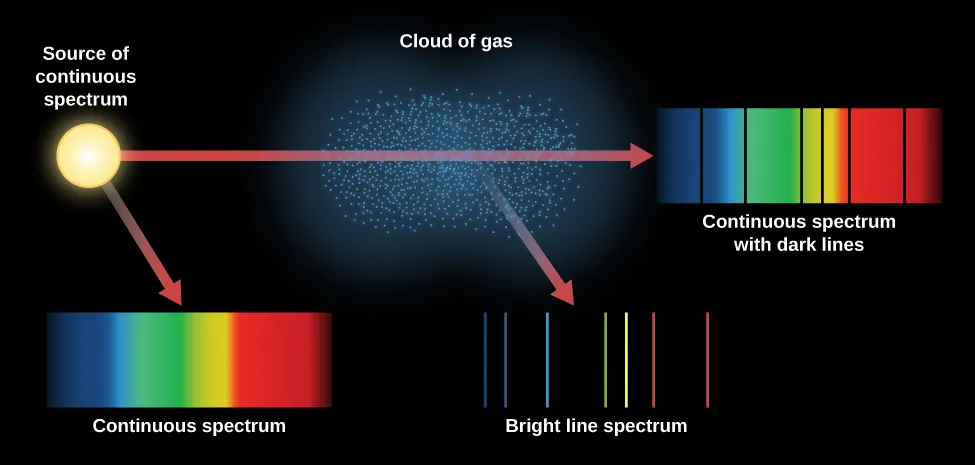
emission line
Definition: A narrow spectral feature where intensity exceeds the surrounding continuum because atoms, ions, or molecules emit at particular transitions.
Why it matters here: Emission lines identify material and diagnose temperature, density, ionization, and motion.
Relationships: The line wavelength reflects an energy-level difference; Doppler shifts move the observed wavelength.
Boundary or common confusion: A line's strength is not a simple abundance meter because excitation, opacity, and geometry also matter.
absorption line
Definition: A narrow reduction in intensity where intervening material removes photons at specific transition wavelengths.
Why it matters here: Stellar absorption lines reveal atmospheric composition, temperature class, pressure, and radial motion.
Relationships: They occur when cooler gas lies in front of a brighter continuous source and share transition wavelengths with corresponding emission lines.
Boundary or common confusion: A missing or weak line does not prove an element is absent; the atoms may be in the wrong excitation or ionization state.
Doppler shift
Definition: A change in observed wavelength or frequency caused by relative line-of-sight motion between source and observer.
Why it matters here: It measures radial velocity in stars, gas clouds, galaxies, and exoplanet-host systems.
Relationships: At speeds much less than light, \(\Delta\lambda/\lambda_0\approx v_r/c\).
Boundary or common confusion: It measures only the line-of-sight component, and cosmological redshift requires a broader expansion model at large distances.
\[ \frac{\Delta\lambda}{\lambda_0}\approx\frac{v_r}{c} \]