Reading Anchor
OpenStax Astronomy 2e, Chapter 6.1-6.5 on telescopes, detectors, resolution, and multiwavelength observing. The local textbook reference is stored at references/openstax-astronomy-2e.pdf. These notes use the textbook for scope and terminology while presenting original explanations and examples.
Lecture Arc
A telescope is not simply a magnifier. It is a measuring system whose aperture, optics, detector, atmosphere, and calibration determine what can be learned.
The lecture should begin by asking students what can be observed directly. Only after that should the explanatory model be introduced. This helps students distinguish evidence from interpretation, a distinction that becomes essential when the course moves from the night sky to stars, galaxies, and cosmology.
Terms Developed in Context
These terms form a connected reasoning system for the lecture. Each entry extends the concise slide panel by showing how the term is used, what it is linked to observationally or mathematically, and where its interpretation can fail.
- aperture
The effective diameter of a telescope's primary light-collecting opening. Aperture sets both photon-collecting power and the best possible diffraction-limited angular resolution. Collecting area grows as \(D^2\), while diffraction angle shrinks approximately as \(\lambda/D\).
In context: Doubling diameter gives four times the collecting area. For ground-based optical telescopes, adaptive optics or interferometry may be needed to approach the diffraction limit. Boundary: A larger aperture cannot by itself remove atmospheric seeing, tracking errors, or detector noise.
- collecting area
The effective surface area that intercepts incoming radiation. It controls the photon rate and therefore how faint a source can be measured in a given exposure. For an unobscured circular aperture, \(A=\pi D^2/4\); signal-to-noise then also depends on background and detector properties.
In context: Collecting area improves sensitivity, not magnification by itself. Comparing telescopes requires effective throughput across the wavelength band, not diameter alone. Boundary: Central obstructions, reflectivity losses, and instrument throughput reduce effective area below geometric area.
- resolution
The ability of an observing system to distinguish nearby details or sources as separate. Resolution determines whether structure is measured or blurred together. The diffraction scale for a circular aperture is approximately \(\theta=1.22\lambda/D\), but seeing and detector sampling can dominate.
In context: Angular resolution must be compared with pixel scale and source separation. Spectral and temporal resolution are analogous ideas in wavelength and time rather than angle. Boundary: Resolution is not the same as magnification; enlarging a blurred image does not recover missing detail.
- seeing
Atmospheric blurring and image motion caused mainly by turbulent variations in refractive index. It often sets the practical resolution of ground-based optical images. Seeing is measured as an angular width of stellar images and can be improved with site selection, short exposures, or adaptive optics.
In context: A night can be transparent but have poor seeing, or clear stellar images can occur through a somewhat less transparent atmosphere. Space telescopes avoid atmospheric seeing but retain diffraction and engineering limits. Boundary: Seeing is distinct from cloud cover, transparency, and diffraction, though all affect observing quality.
- field of view
The angular region of sky recorded or visible in one observation. It controls target framing, survey speed, and whether comparison stars or extended structures fit in the image. Field of view depends on focal length and detector dimensions; pixel scale partitions it into samples.
In context: Instrument design trades field size against sampling, aberration control, and data volume. Observers should distinguish a single detector's field from a survey's total sky coverage. Boundary: A wide field does not guarantee high resolution or sensitivity.
- detector
A device that converts incident radiation into measurable electrical or digital signals. Detector response determines wavelength sensitivity, noise, dynamic range, and calibration strategy. A telescope forms or directs the signal; the detector samples it into counts that must be corrected for bias, dark current, and sensitivity variations.
In context: CCDs, infrared arrays, radio receivers, and particle detectors use different conversion processes. Quantum efficiency gives the fraction of incident photons that contribute detected signal. Boundary: Recorded counts are not automatically calibrated physical fluxes.
- signal-to-noise
The ratio of the measured source signal to the uncertainty in that measurement. It quantifies whether a detection or feature is statistically useful rather than merely visible. In a source-dominated photon-counting limit, \({\rm S/N}\approx\sqrt{N}\), so quadrupling photons roughly doubles S/N.
In context: Background sky, read noise, dark current, and source counts all enter a realistic noise budget. Reporting S/N without defining the aperture, wavelength bin, or measurement is incomplete. Boundary: Longer exposure cannot average away all systematic errors, saturation, confusion, or calibration bias.
Evidence Table
| # | Evidence or observation | How students should interrogate it |
|---|---|---|
| 1 | Larger apertures collect more photons and can reveal fainter targets. | What measurement, image, spectrum, or sky observation would support this? |
| 2 | Atmospheric turbulence blurs images even when optics are excellent. | What measurement, image, spectrum, or sky observation would support this? |
| 3 | Detectors count photons with noise, bias, and calibration limits. | What measurement, image, spectrum, or sky observation would support this? |
Model Development
The model for this lecture has three linked parts:
- Resolution is limited by diffraction and often by atmosphere.
- Signal-to-noise improves with more photons but not all noise averages away equally.
- The best instrument depends on the scientific question, wavelength, and target brightness.
The instructor should emphasize where the model is a simplification. Introductory astronomy often works by adopting a useful first model, identifying its assumptions, and then refining it when new evidence demands more detail.
Quantitative Reasoning
This equation or proportionality is not just a formula to memorize. It is a compact statement of a physical or geometric relationship. A strong student solution defines each symbol, states the unit system, identifies the assumptions, and interprets the result in words.
Worked Example
- A 1 m telescope has 100 times the collecting area of a 10 cm telescope.
- At the same wavelength, its diffraction limit is 10 times smaller.
- In practice, seeing may dominate for ground-based optical observations.
After completing the calculation, students should ask whether the result is plausible. A numerical answer without a reasonableness check is not yet a scientific conclusion.
Visual Interpretation
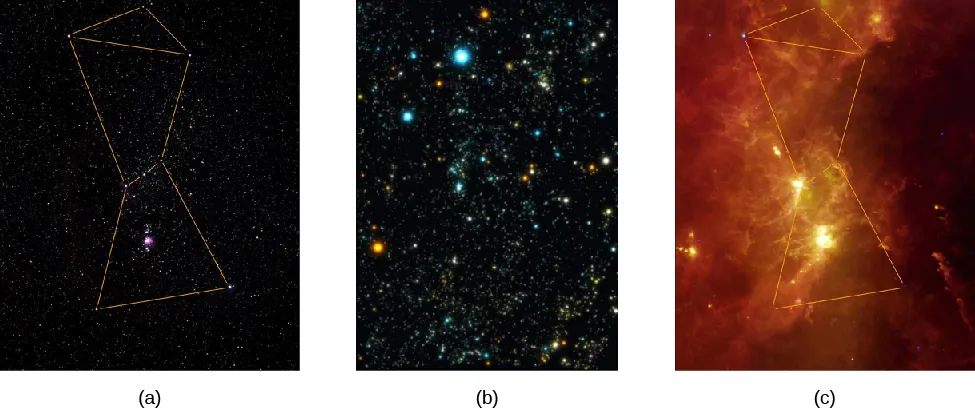
The same sky field becomes different evidence when detector wavelength changes. Credit: OpenStax Astronomy 2e, Fig. 6.2, CC BY-NC-SA 4.0; source credits include Howard McCallon/NASA/IRAS and Michael F. Corcoran.
Misconception and Boundary Condition
The correction should not be presented as a slogan. It should be tied to the evidence and model from this lecture. Students should practice saying what would be different if the misconception were true.
Active Learning Plan
Students choose an observing setup for a faint galaxy, a bright planet, and a wide star field, defending different instrument choices.
A suggested timing is 2 minutes individual prediction, 3 minutes peer comparison, and 3 minutes whole-class synthesis. The point is to make students commit to a model before seeing the instructor's full explanation.
Lab or Observing Connection
Lab 05 connects telescope setup, field of view, image scale, and observing constraints.
Students should see the lab as a continuation of lecture reasoning. The lab does not merely demonstrate a concept; it asks students to collect, interpret, or critique evidence with uncertainty.
Synthesis and Study Questions
Instrumentation defines the evidence. A measurement is only as meaningful as the observing system and calibration behind it.
- What was the central observation or evidence pattern?
- What model explains it, and what assumptions does the model make?
- Where did quantitative reasoning constrain the claim?
- What uncertainty, limitation, or misconception remains important?
References
- OpenStax, Astronomy 2e: OpenStax Astronomy 2e, Chapter 6.1-6.5 on telescopes, detectors, resolution, and multiwavelength observing.
- Course reference log:
../reference-log.md.