Reading Anchor
OpenStax Astronomy 2e, Chapter 25.1-25.6 on Milky Way structure, stellar populations, gas, dust, and galactic mass. The local textbook reference is stored at references/openstax-astronomy-2e.pdf. These notes use the textbook for scope and terminology while presenting original explanations and examples.
Lecture Arc
We live inside a galaxy, so mapping it is like trying to infer a forest while standing among the trees.
The lecture should begin by asking students what can be observed directly. Only after that should the explanatory model be introduced. This helps students distinguish evidence from interpretation, a distinction that becomes essential when the course moves from the night sky to stars, galaxies, and cosmology.
Terms Developed in Context
These terms form a connected reasoning system for the lecture. Each entry extends the concise slide panel by showing how the term is used, what it is linked to observationally or mathematically, and where its interpretation can fail.
- disk
The flattened rotating component of the Milky Way containing much of its gas, dust, and ongoing star formation. It is the Galaxy component in which the Sun resides and where spiral structure is most visible. The disk includes thin and thick stellar populations and surrounds the central bulge.
In context: Young stars and molecular clouds concentrate near the thin disk, while older stars occupy a thicker distribution. Infrared and radio observations penetrate dust better than visible light. Boundary: It is not razor-thin or perfectly circular, and dust obscures optical views through it.
- bulge
The dense, centrally concentrated stellar component of a disk galaxy. Its stars and motions reveal the Milky Way's formation history and central gravitational environment. The Milky Way's bulge is associated with a bar and surrounds the central supermassive black hole.
In context: Bulge populations are generally older than the thin disk, but age and metallicity distributions overlap. Dust makes its three-dimensional structure difficult to infer from optical images alone. Boundary: A bulge is not simply a scaled-up spherical star cluster; it can be barred, boxy, and dynamically complex.
- halo
A roughly extended, low-density component surrounding the Galaxy's disk and bulge. It contains old stars and globular clusters and is embedded in a much more massive dark-matter halo. Halo-star orbits differ from orderly disk rotation; streams record disrupted satellites.
In context: Stellar-halo metallicities and streams preserve evidence of mergers. Mapping the dark halo relies on gravitational tracers rather than direct images. Boundary: The sparse visible stellar halo is not the same thing as the dominant dark-matter halo.
- spiral arm
A curved region in a disk galaxy with enhanced gas, dust, young stars, and star formation. Spiral arms organize where recent star formation is seen and help map galactic structure. They are commonly treated as patterns or waves through which stars and gas move, not permanent material spokes.
In context: Gas compression near an arm can promote cloud collapse. Different tracers—ionized gas, molecular gas, old stars—need not peak at exactly the same location. Boundary: Visible bright stars overemphasize recent star formation and do not trace all of the disk's mass.
- interstellar medium
The gas, dust, cosmic rays, magnetic fields, and radiation occupying space between stars. It supplies material for new stars and receives energy and enriched elements from stellar winds and supernovae. Its cold clouds, warm phases, and hot plasma participate in a star-formation feedback cycle.
In context: Different wavelengths trace different phases: radio molecules, optical emission lines, infrared dust, and X-ray plasma. Observed extinction is both a nuisance and a measurement of dust. Boundary: Interstellar space is not empty, but its density is far below ordinary laboratory vacua and varies enormously.
- rotation curve
A graph of orbital speed versus distance from a galaxy's center. It tests how enclosed gravitating mass changes with radius. For circular motion, \(v^2=GM(<r)/r\); flat outer curves imply increasing enclosed mass beyond most visible light.
In context: If most mass were centrally concentrated, outer speed would decline approximately as \(r^{-1/2}\). The observed near-flat behavior motivates extended dark-matter distributions or alternative gravity tests. Boundary: Interpreting a curve assumes orbital geometry and must account for bars, warps, gas motions, and measurement uncertainties.
- dark matter
Matter inferred from gravity that does not emit, absorb, or scatter enough electromagnetic radiation to be seen directly. It explains a large share of the gravitational mass in galaxies, clusters, and cosmic structure models. Rotation curves, gravitational lensing, cluster dynamics, and cosmology provide independent evidence.
In context: A strong case comes from converging measurements with different systematics. The term should not be confused with dark energy, which affects cosmic expansion rather than clustering like matter. Boundary: Dark matter names an inferred component, not a confirmed particle identity; ordinary faint matter cannot explain all observations.
Evidence Table
| # | Evidence or observation | How students should interrogate it |
|---|---|---|
| 1 | The Milky Way appears as a band because we observe from within its disk. | What measurement, image, spectrum, or sky observation would support this? |
| 2 | Dust blocks visible light but radio and infrared observations reveal hidden structure. | What measurement, image, spectrum, or sky observation would support this? |
| 3 | Rotation speeds imply more mass than visible stars and gas can explain. | What measurement, image, spectrum, or sky observation would support this? |
Model Development
The model for this lecture has three linked parts:
- The Galaxy contains multiple structural components with different stellar populations.
- Gas, dust, and star formation trace spiral structure imperfectly.
- Mass inside an orbit can be inferred from orbital speed under simplifying assumptions.
The instructor should emphasize where the model is a simplification. Introductory astronomy often works by adopting a useful first model, identifying its assumptions, and then refining it when new evidence demands more detail.
Quantitative Reasoning
This equation or proportionality is not just a formula to memorize. It is a compact statement of a physical or geometric relationship. A strong student solution defines each symbol, states the unit system, identifies the assumptions, and interprets the result in words.
Worked Example
- If orbital speed remains flat as radius grows, enclosed mass must keep increasing roughly with radius.
- Visible matter does not rise that way at large radii.
- The mismatch is one line of evidence for dark matter.
After completing the calculation, students should ask whether the result is plausible. A numerical answer without a reasonableness check is not yet a scientific conclusion.
Visual Interpretation
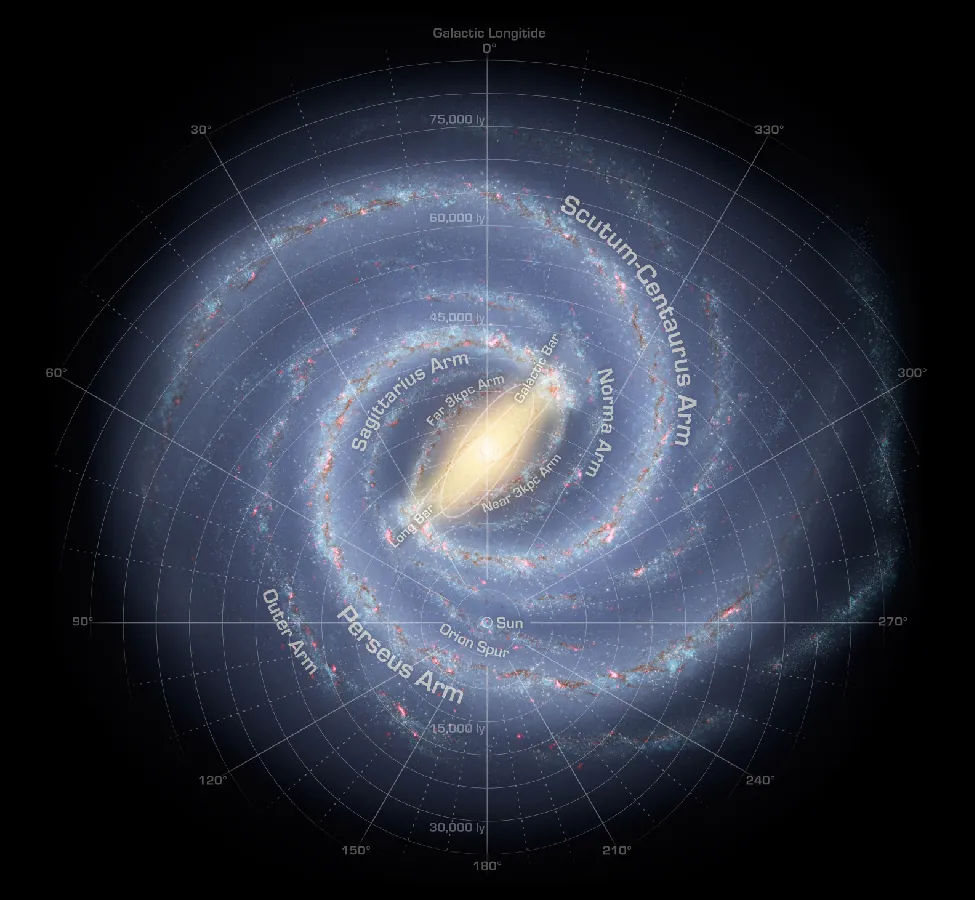
Infrared-derived structure lets us infer the barred spiral form from inside the disk. Credit: OpenStax Astronomy 2e, Fig. 25.10, CC BY-NC-SA 4.0; based on NASA/JPL-Caltech/R. Hurt (SSC/Caltech).
Misconception and Boundary Condition
The correction should not be presented as a slogan. It should be tied to the evidence and model from this lecture. Students should practice saying what would be different if the misconception were true.
Active Learning Plan
Students match Milky Way components to tracers: young stars, globular clusters, gas, dust, and old halo stars.
A suggested timing is 2 minutes individual prediction, 3 minutes peer comparison, and 3 minutes whole-class synthesis. The point is to make students commit to a model before seeing the instructor's full explanation.
Lab or Observing Connection
A Milky Way mapping activity interprets gas or rotation-curve evidence.
Students should see the lab as a continuation of lecture reasoning. The lab does not merely demonstrate a concept; it asks students to collect, interpret, or critique evidence with uncertainty.
Synthesis and Study Questions
Galactic structure is inferred by combining geometry, motion, wavelength choice, and population clues.
- What was the central observation or evidence pattern?
- What model explains it, and what assumptions does the model make?
- Where did quantitative reasoning constrain the claim?
- What uncertainty, limitation, or misconception remains important?
References
- OpenStax, Astronomy 2e: OpenStax Astronomy 2e, Chapter 25.1-25.6 on Milky Way structure, stellar populations, gas, dust, and galactic mass.
- Course reference log:
../reference-log.md.