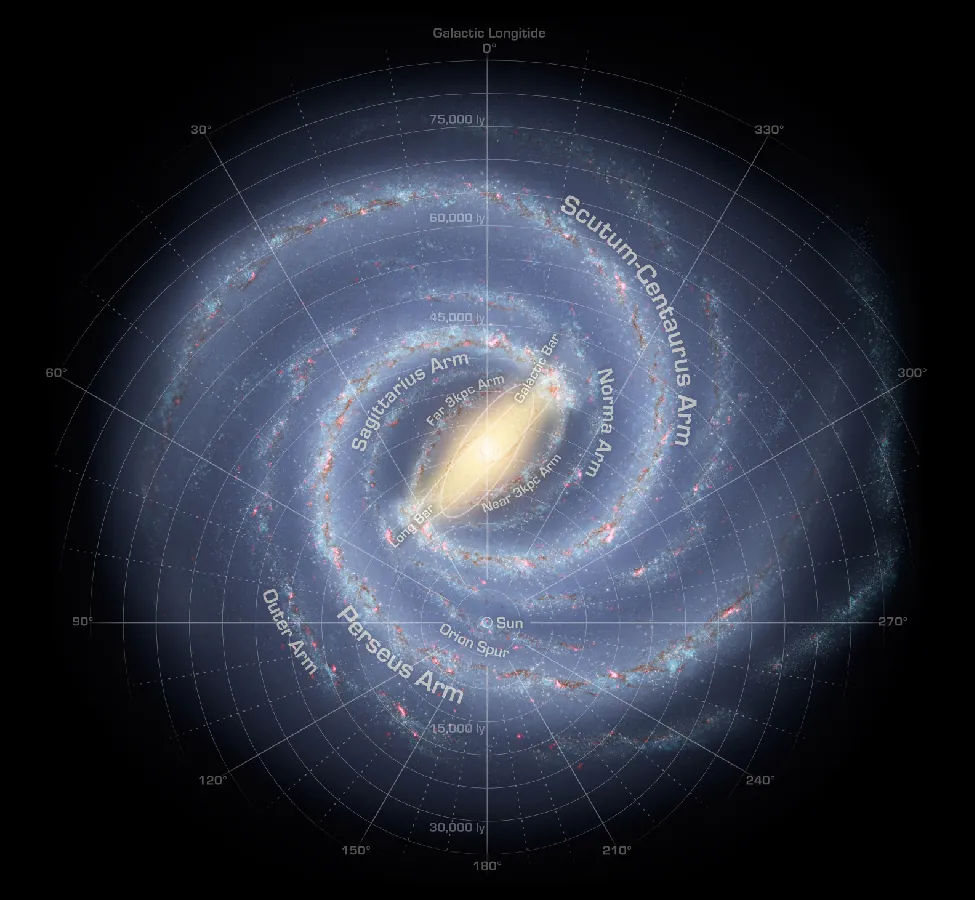
disk
Definition: The flattened rotating component of the Milky Way containing much of its gas, dust, and ongoing star formation.
Why it matters here: It is the Galaxy component in which the Sun resides and where spiral structure is most visible.
Relationships: The disk includes thin and thick stellar populations and surrounds the central bulge.
Boundary or common confusion: It is not razor-thin or perfectly circular, and dust obscures optical views through it.
bulge
Definition: The dense, centrally concentrated stellar component of a disk galaxy.
Why it matters here: Its stars and motions reveal the Milky Way's formation history and central gravitational environment.
Relationships: The Milky Way's bulge is associated with a bar and surrounds the central supermassive black hole.
Boundary or common confusion: A bulge is not simply a scaled-up spherical star cluster; it can be barred, boxy, and dynamically complex.
halo
Definition: A roughly extended, low-density component surrounding the Galaxy's disk and bulge.
Why it matters here: It contains old stars and globular clusters and is embedded in a much more massive dark-matter halo.
Relationships: Halo-star orbits differ from orderly disk rotation; streams record disrupted satellites.
Boundary or common confusion: The sparse visible stellar halo is not the same thing as the dominant dark-matter halo.
spiral arm
Definition: A curved region in a disk galaxy with enhanced gas, dust, young stars, and star formation.
Why it matters here: Spiral arms organize where recent star formation is seen and help map galactic structure.
Relationships: They are commonly treated as patterns or waves through which stars and gas move, not permanent material spokes.
Boundary or common confusion: Visible bright stars overemphasize recent star formation and do not trace all of the disk's mass.
interstellar medium
Definition: The gas, dust, cosmic rays, magnetic fields, and radiation occupying space between stars.
Why it matters here: It supplies material for new stars and receives energy and enriched elements from stellar winds and supernovae.
Relationships: Its cold clouds, warm phases, and hot plasma participate in a star-formation feedback cycle.
Boundary or common confusion: Interstellar space is not empty, but its density is far below ordinary laboratory vacua and varies enormously.
rotation curve
Definition: A graph of orbital speed versus distance from a galaxy's center.
Why it matters here: It tests how enclosed gravitating mass changes with radius.
Relationships: For circular motion, \(v^2=GM(<r)/r\); flat outer curves imply increasing enclosed mass beyond most visible light.
Boundary or common confusion: Interpreting a curve assumes orbital geometry and must account for bars, warps, gas motions, and measurement uncertainties.
\[ v^2(r)=\frac{GM(
dark matter
Definition: Matter inferred from gravity that does not emit, absorb, or scatter enough electromagnetic radiation to be seen directly.
Why it matters here: It explains a large share of the gravitational mass in galaxies, clusters, and cosmic structure models.
Relationships: Rotation curves, gravitational lensing, cluster dynamics, and cosmology provide independent evidence.
Boundary or common confusion: Dark matter names an inferred component, not a confirmed particle identity; ordinary faint matter cannot explain all observations.
Active Learning Segment
Students match Milky Way components to tracers: young stars, globular clusters, gas, dust, and old halo stars.
Write a prediction first, compare reasoning with a neighbor, then revise your answer in one sentence.