Reading Anchor
OpenStax Astronomy 2e, Chapters 26.1-26.5 and 27.1-27.4 on galaxy types, distances, active galaxies, and galaxy evolution. The local textbook reference is stored at references/openstax-astronomy-2e.pdf. These notes use the textbook for scope and terminology while presenting original explanations and examples.
Lecture Arc
Galaxies are not isolated static islands. Their shapes, colors, star formation, and activity carry evidence of environment and history.
The lecture should begin by asking students what can be observed directly. Only after that should the explanatory model be introduced. This helps students distinguish evidence from interpretation, a distinction that becomes essential when the course moves from the night sky to stars, galaxies, and cosmology.
Terms Developed in Context
These terms form a connected reasoning system for the lecture. Each entry extends the concise slide panel by showing how the term is used, what it is linked to observationally or mathematically, and where its interpretation can fail.
- spiral galaxy
A galaxy with a rotating stellar disk, gas and dust, and often spiral arms surrounding a central bulge. Its structure connects angular momentum, ongoing star formation, and environmental history. Spirals tend to contain colder gas and bluer young populations than many ellipticals.
In context: Bars are common within spiral galaxies and can move gas inward. Inclination and wavelength can hide or exaggerate spiral structure. Boundary: Morphology alone does not specify mass, age, or a fixed evolutionary stage.
- elliptical galaxy
A galaxy with a smooth ellipsoidal light distribution and little obvious disk or spiral structure. Ellipticals provide evidence about stellar aging, mergers, gas loss, and pressure-supported dynamics. Their stars commonly have more randomly oriented motions than stars in a cold rotating disk.
In context: The largest ellipticals often occupy cluster centers and may have complex assembly histories. Apparent shape is a projected view of a three-dimensional stellar distribution. Boundary: Elliptical does not mean featureless or uniformly old, and some retain gas, dust, or recent star formation.
- irregular galaxy
A galaxy lacking a clear spiral or elliptical form at the observed scale and wavelength. Irregular structure can expose tidal disturbance, intense star formation, or low-mass disk dynamics. Some irregulars result from interactions, while others are isolated dwarf systems.
In context: Resolution and observing band affect classification: a high-redshift galaxy may appear irregular because only bright star-forming clumps are detected. Kinematic data can reveal order hidden from images. Boundary: The label describes appearance, not one formation mechanism.
- redshift
The fractional increase in observed wavelength relative to a laboratory or emitted reference wavelength. It measures line-of-sight motion at low speeds and traces cosmic expansion for distant galaxies. It is defined by \(z=(\lambda_{\rm obs}-\lambda_0)/\lambda_0\); at small \(z\), \(v\approx cz\).
In context: Spectral patterns establish redshift by matching multiple lines. Peculiar velocity adds scatter to the expansion relation, especially for nearby galaxies. Boundary: Large cosmological redshift is not adequately described as an ordinary speed through static space.
- starburst
An episode of unusually intense star formation relative to a galaxy's past average or available gas. Starbursts rapidly transform gas, dust, luminosity, chemical enrichment, and feedback. Interactions and mergers can compress gas and trigger bursts; massive young stars then produce ultraviolet light and supernovae.
In context: A starburst is temporary because rapid gas consumption and feedback cannot continue indefinitely. Star-formation rates require wavelength-dependent calibration and assumptions about the stellar population. Boundary: Bright infrared or ultraviolet emission can be obscured or contaminated by an active nucleus.
- active galactic nucleus
A compact, unusually luminous galactic center powered by matter accreting onto a supermassive black hole. AGN can outshine their host galaxies and influence surrounding gas through radiation, winds, and jets. Accretion converts gravitational energy into radiation; orientation and obscuration help explain observed AGN classes.
In context: Spectra, variability, radio jets, and high-energy emission provide complementary diagnostics. AGN feedback is important in galaxy-evolution models but is difficult to quantify. Boundary: A central point source is not automatically an AGN, and black-hole mass alone does not set luminosity without fuel.
- merger
The gravitational interaction and eventual combination of two or more galaxies. Mergers rearrange stellar orbits, compress gas, trigger star formation or AGN activity, and build galactic structure. Tidal tails and distorted morphologies are evidence of interaction; dark-matter halos strongly affect the dynamics.
In context: Dynamical friction transfers orbital energy and helps galaxy cores coalesce. The final morphology depends on mass ratio, gas fraction, orbit, and feedback. Boundary: Most stars do not collide directly because stellar separations are enormous, even though the galaxies merge.
Evidence Table
| # | Evidence or observation | How students should interrogate it |
|---|---|---|
| 1 | Galaxy colors and spectra trace stellar populations and star formation. | What measurement, image, spectrum, or sky observation would support this? |
| 2 | Tidal tails, bridges, and disturbed shapes reveal interactions. | What measurement, image, spectrum, or sky observation would support this? |
| 3 | Redshift connects spectra to motion and, in cosmology, distance scale. | What measurement, image, spectrum, or sky observation would support this? |
Model Development
The model for this lecture has three linked parts:
- Morphology is a useful description but not a complete evolutionary sequence.
- Interactions redistribute gas and stars and can trigger star formation.
- Supermassive black hole accretion can produce active galactic nuclei.
The instructor should emphasize where the model is a simplification. Introductory astronomy often works by adopting a useful first model, identifying its assumptions, and then refining it when new evidence demands more detail.
Quantitative Reasoning
This equation or proportionality is not just a formula to memorize. It is a compact statement of a physical or geometric relationship. A strong student solution defines each symbol, states the unit system, identifies the assumptions, and interprets the result in words.
Worked Example
- A spectral line with rest wavelength 500.7 nm observed at 550.8 nm has z about 0.10.
- At low redshift, this corresponds approximately to recession speed 0.10c.
- For larger redshift, cosmological interpretation requires a more careful model.
After completing the calculation, students should ask whether the result is plausible. A numerical answer without a reasonableness check is not yet a scientific conclusion.
Visual Interpretation
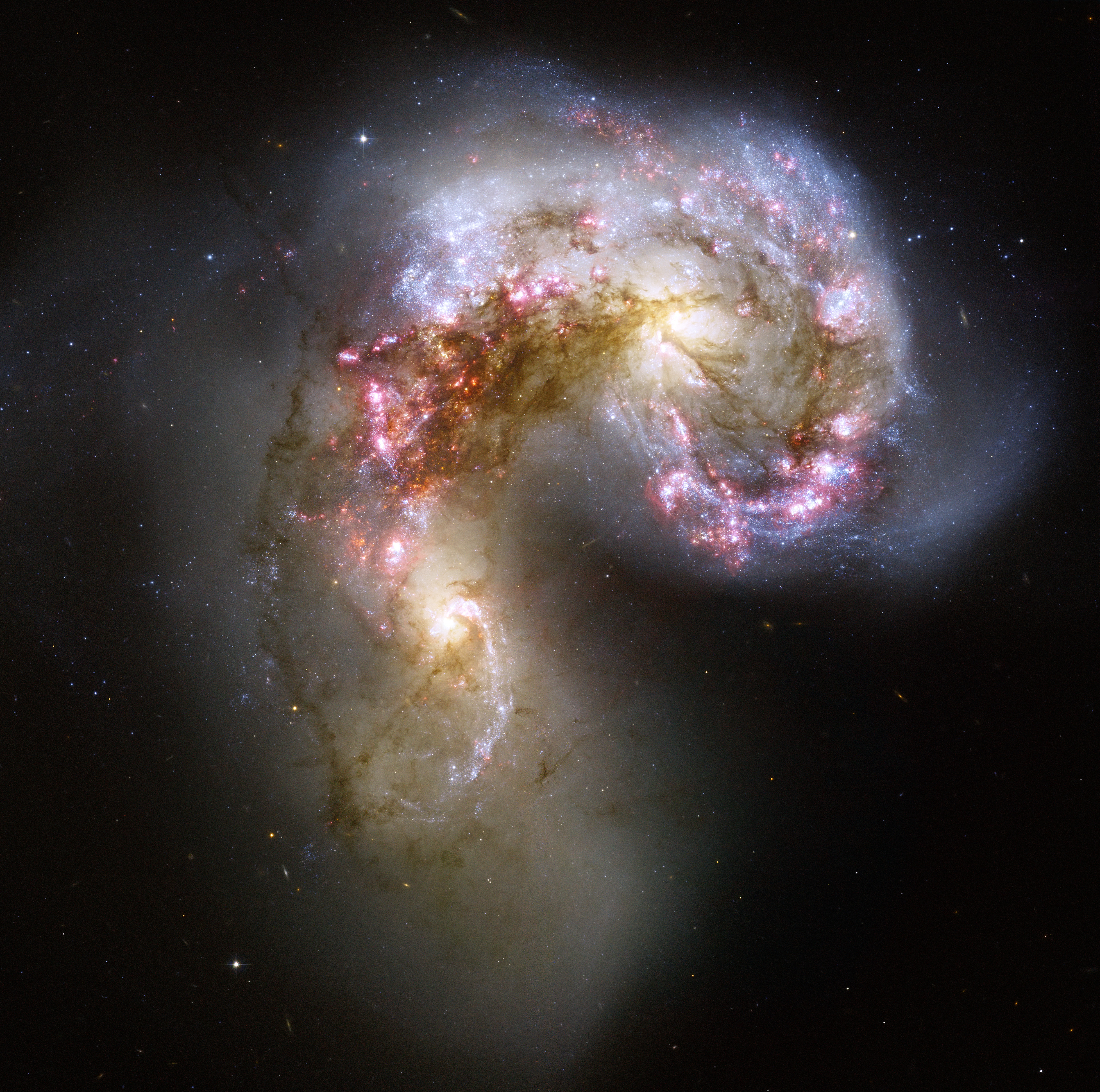
Tidal distortion and compact blue star clusters show that galaxy morphology can record interaction history. Credit: NASA, ESA, and the Hubble Heritage Team (STScI/AURA)-ESA/Hubble Collaboration; acknowledgement B. Whitmore and James Long; CC BY 4.0.
Misconception and Boundary Condition
The correction should not be presented as a slogan. It should be tied to the evidence and model from this lecture. Students should practice saying what would be different if the misconception were true.
Active Learning Plan
Students classify galaxy images, justify criteria, and identify at least one ambiguous or interaction-disturbed case.
A suggested timing is 2 minutes individual prediction, 3 minutes peer comparison, and 3 minutes whole-class synthesis. The point is to make students commit to a model before seeing the instructor's full explanation.
Lab or Observing Connection
Lab 08 applies documented morphology criteria and simple redshift interpretation.
Students should see the lab as a continuation of lecture reasoning. The lab does not merely demonstrate a concept; it asks students to collect, interpret, or critique evidence with uncertainty.
Synthesis and Study Questions
Galaxies connect local astrophysics to cosmic history: stars, gas, black holes, dark matter, and environment all matter.
- What was the central observation or evidence pattern?
- What model explains it, and what assumptions does the model make?
- Where did quantitative reasoning constrain the claim?
- What uncertainty, limitation, or misconception remains important?
References
- OpenStax, Astronomy 2e: OpenStax Astronomy 2e, Chapters 26.1-26.5 and 27.1-27.4 on galaxy types, distances, active galaxies, and galaxy evolution.
- Course reference log:
../reference-log.md.