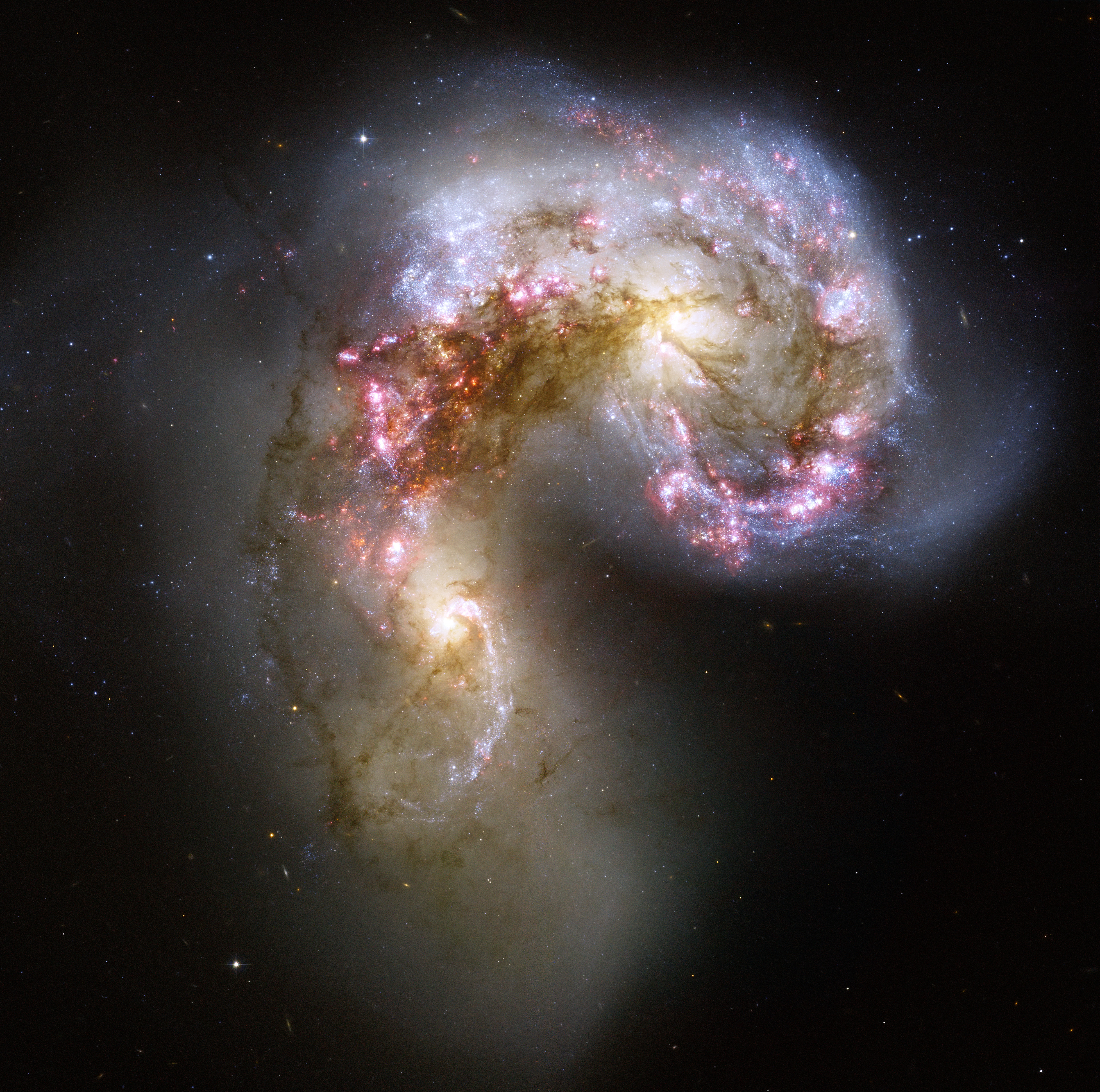
spiral galaxy
Definition: A galaxy with a rotating stellar disk, gas and dust, and often spiral arms surrounding a central bulge.
Why it matters here: Its structure connects angular momentum, ongoing star formation, and environmental history.
Relationships: Spirals tend to contain colder gas and bluer young populations than many ellipticals.
Boundary or common confusion: Morphology alone does not specify mass, age, or a fixed evolutionary stage.
elliptical galaxy
Definition: A galaxy with a smooth ellipsoidal light distribution and little obvious disk or spiral structure.
Why it matters here: Ellipticals provide evidence about stellar aging, mergers, gas loss, and pressure-supported dynamics.
Relationships: Their stars commonly have more randomly oriented motions than stars in a cold rotating disk.
Boundary or common confusion: Elliptical does not mean featureless or uniformly old, and some retain gas, dust, or recent star formation.
irregular galaxy
Definition: A galaxy lacking a clear spiral or elliptical form at the observed scale and wavelength.
Why it matters here: Irregular structure can expose tidal disturbance, intense star formation, or low-mass disk dynamics.
Relationships: Some irregulars result from interactions, while others are isolated dwarf systems.
Boundary or common confusion: The label describes appearance, not one formation mechanism.
redshift
Definition: The fractional increase in observed wavelength relative to a laboratory or emitted reference wavelength.
Why it matters here: It measures line-of-sight motion at low speeds and traces cosmic expansion for distant galaxies.
Relationships: It is defined by \(z=(\lambda_{\rm obs}-\lambda_0)/\lambda_0\); at small \(z\), \(v\approx cz\).
Boundary or common confusion: Large cosmological redshift is not adequately described as an ordinary speed through static space.
\[ z=\frac{\lambda_{\rm obs}-\lambda_0}{\lambda_0} \]
starburst
Definition: An episode of unusually intense star formation relative to a galaxy's past average or available gas.
Why it matters here: Starbursts rapidly transform gas, dust, luminosity, chemical enrichment, and feedback.
Relationships: Interactions and mergers can compress gas and trigger bursts; massive young stars then produce ultraviolet light and supernovae.
Boundary or common confusion: Bright infrared or ultraviolet emission can be obscured or contaminated by an active nucleus.
active galactic nucleus
Definition: A compact, unusually luminous galactic center powered by matter accreting onto a supermassive black hole.
Why it matters here: AGN can outshine their host galaxies and influence surrounding gas through radiation, winds, and jets.
Relationships: Accretion converts gravitational energy into radiation; orientation and obscuration help explain observed AGN classes.
Boundary or common confusion: A central point source is not automatically an AGN, and black-hole mass alone does not set luminosity without fuel.
merger
Definition: The gravitational interaction and eventual combination of two or more galaxies.
Why it matters here: Mergers rearrange stellar orbits, compress gas, trigger star formation or AGN activity, and build galactic structure.
Relationships: Tidal tails and distorted morphologies are evidence of interaction; dark-matter halos strongly affect the dynamics.
Boundary or common confusion: Most stars do not collide directly because stellar separations are enormous, even though the galaxies merge.