Reading Anchor
OpenStax Astronomy 2e, Chapter 29.1-29.6 on redshift, expansion, the Hubble law, cosmic background radiation, and cosmological evidence. The local textbook reference is stored at references/openstax-astronomy-2e.pdf. These notes use the textbook for scope and terminology while presenting original explanations and examples.
Lecture Arc
On the largest scales, galaxies trace an expanding universe with a measurable history, composition, and structure.
The lecture should begin by asking students what can be observed directly. Only after that should the explanatory model be introduced. This helps students distinguish evidence from interpretation, a distinction that becomes essential when the course moves from the night sky to stars, galaxies, and cosmology.
Terms Developed in Context
These terms form a connected reasoning system for the lecture. Each entry extends the concise slide panel by showing how the term is used, what it is linked to observationally or mathematically, and where its interpretation can fail.
- expansion
The time-dependent increase of distances between sufficiently separated, unbound cosmic locations as described by the changing cosmological scale factor. It organizes the redshift-distance relation and the thermal history of the universe. The Hubble parameter is \(\dot a/a\); redshift links observed wavelength to the scale factor at emission.
In context: Galaxies can also have peculiar velocities through their local environment. Expansion is homogeneous on large scales and has no unique spatial center within the standard model. Boundary: Expansion does not make bound systems such as atoms, people, or the solar system grow.
- Hubble-Lemaitre law
The approximate proportionality between recession velocity and distance for nearby galaxies participating in cosmic expansion. Its slope measures the present expansion rate and provides a first distance-redshift tool. The low-redshift form is \(v=H_0d\); scatter includes peculiar velocities and distance errors.
In context: Estimating \(H_0\) requires independent distances and calibrated redshifts. Different modern methods have produced a well-known tension that is still investigated. Boundary: It is a local approximation and must be replaced by a cosmological model at large redshift.
- cosmic microwave background
Nearly uniform microwave radiation released when the early universe became transparent, now cooled by expansion. Its spectrum and tiny anisotropies provide precise evidence about the early universe and cosmological parameters. Expansion stretches the radiation to a present blackbody temperature near 2.7 K; anisotropies seed later structure.
In context: The CMB last-scattering surface is seen in every direction because every observer is surrounded by their own observable boundary. Foreground emission must be separated from the cosmological signal. Boundary: It is not light from the Big Bang's first instant and does not come from one distant shell centered on Earth.
- lookback time
The elapsed cosmic time between emission of the light we observe and its reception now. It makes distant observations a record of earlier stages of cosmic history. Lookback time depends on redshift and the expansion history, not simply distance divided by today's Hubble speed.
In context: At substantial redshift, several distance definitions coexist because spacetime evolves while light travels. A cosmological model is needed to translate redshift into time. Boundary: It is not the current age of the observed object or its present-day distance.
- dark matter
A nonluminous gravitating matter component that clusters and helps build galaxies and larger structures. Cosmological structure grows too slowly from the observed early fluctuations without a dominant cold matter component. CMB anisotropies, lensing, galaxy clustering, and galaxy dynamics constrain its abundance and distribution.
In context: In cosmology, dark matter supplies gravitational wells into which ordinary gas falls. Models must match evidence from both early-universe and late-time structure. Boundary: Its particle nature remains unknown, and it is distinct from dark energy.
- dark energy
The name for the component or effect associated with the observed accelerated expansion of the universe. It dominates the present cosmic energy budget in the standard model and changes distance-redshift relations. Supernova distances, CMB constraints, and large-scale clustering jointly constrain its behavior.
In context: Dark energy remains smooth on galaxy scales in the standard picture and does not behave like unseen matter in rotation curves. Its pressure and equation-of-state parameter govern expansion dynamics. Boundary: The label does not identify a known substance; a cosmological constant is the simplest model, not a settled mechanism.
- large-scale structure
The cosmic network of galaxies, groups, clusters, filaments, walls, and voids on millions to billions of light-years. Its statistics test how primordial fluctuations grew under gravity and expansion. Dark matter supplies the main gravitational framework; galaxy surveys trace it with selection-dependent bias.
In context: Redshift gives a radial coordinate only after applying a cosmological model and correcting for peculiar velocities. Simulations compare predicted clustering with observed statistics. Boundary: Survey maps are incomplete observational samples, not direct three-dimensional pictures of all matter.
Evidence Table
| # | Evidence or observation | How students should interrogate it |
|---|---|---|
| 1 | Distant galaxies show systematic redshifts. | What measurement, image, spectrum, or sky observation would support this? |
| 2 | The cosmic microwave background is nearly uniform but has tiny structure. | What measurement, image, spectrum, or sky observation would support this? |
| 3 | Galaxy clustering and lensing reveal matter distribution across cosmic time. | What measurement, image, spectrum, or sky observation would support this? |
Model Development
The model for this lecture has three linked parts:
- Expansion relates redshift and distance, but recession is not ordinary motion through static space.
- The Big Bang model describes a hot dense early state, not an explosion into pre-existing space.
- Modern cosmology fits multiple evidence streams with a small set of parameters.
The instructor should emphasize where the model is a simplification. Introductory astronomy often works by adopting a useful first model, identifying its assumptions, and then refining it when new evidence demands more detail.
Quantitative Reasoning
This equation or proportionality is not just a formula to memorize. It is a compact statement of a physical or geometric relationship. A strong student solution defines each symbol, states the unit system, identifies the assumptions, and interprets the result in words.
Worked Example
- Using H0 = 70 km/s/Mpc, a galaxy at 100 Mpc has approximate recession speed 7000 km/s.
- This low-redshift calculation is a first model, not a complete distance-redshift relation.
- Uncertainty in distance and peculiar velocity affects the inference.
After completing the calculation, students should ask whether the result is plausible. A numerical answer without a reasonableness check is not yet a scientific conclusion.
Visual Interpretation
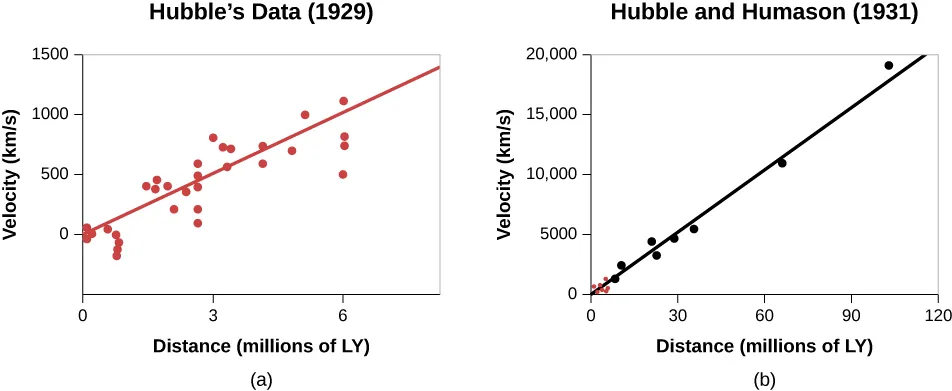
The slope of recession velocity versus distance is the Hubble constant; the historical data also show scatter and calibration limits. Credit: OpenStax Astronomy 2e, Fig. 26.15, CC BY-NC-SA 4.0; adapted from Hubble and Humason data.
Misconception and Boundary Condition
The correction should not be presented as a slogan. It should be tied to the evidence and model from this lecture. Students should practice saying what would be different if the misconception were true.
Active Learning Plan
Students interpret a redshift-distance plot and identify scatter, slope, outliers, and model limitations.
A suggested timing is 2 minutes individual prediction, 3 minutes peer comparison, and 3 minutes whole-class synthesis. The point is to make students commit to a model before seeing the instructor's full explanation.
Lab or Observing Connection
The analysis activity uses redshift-distance data and discusses limits of simple Hubble-law reasoning.
Students should see the lab as a continuation of lecture reasoning. The lab does not merely demonstrate a concept; it asks students to collect, interpret, or critique evidence with uncertainty.
Synthesis and Study Questions
Cosmology is evidence synthesis at scale: redshift, background radiation, element abundances, and structure must agree.
- What was the central observation or evidence pattern?
- What model explains it, and what assumptions does the model make?
- Where did quantitative reasoning constrain the claim?
- What uncertainty, limitation, or misconception remains important?
References
- OpenStax, Astronomy 2e: OpenStax Astronomy 2e, Chapter 29.1-29.6 on redshift, expansion, the Hubble law, cosmic background radiation, and cosmological evidence.
- Course reference log:
../reference-log.md.