expansion
Definition: The time-dependent increase of distances between sufficiently separated, unbound cosmic locations as described by the changing cosmological scale factor.
Why it matters here: It organizes the redshift-distance relation and the thermal history of the universe.
Relationships: The Hubble parameter is \(\dot a/a\); redshift links observed wavelength to the scale factor at emission.
Boundary or common confusion: Expansion does not make bound systems such as atoms, people, or the solar system grow.
\[ H(t)=\frac{\dot a}{a} \]
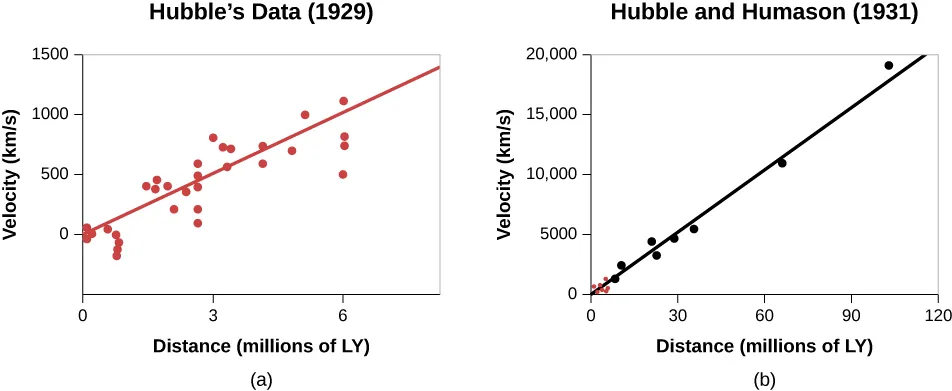
Hubble-Lemaitre law
Definition: The approximate proportionality between recession velocity and distance for nearby galaxies participating in cosmic expansion.
Why it matters here: Its slope measures the present expansion rate and provides a first distance-redshift tool.
Relationships: The low-redshift form is \(v=H_0d\); scatter includes peculiar velocities and distance errors.
Boundary or common confusion: It is a local approximation and must be replaced by a cosmological model at large redshift.
\[ v=H_0d \]
cosmic microwave background
Definition: Nearly uniform microwave radiation released when the early universe became transparent, now cooled by expansion.
Why it matters here: Its spectrum and tiny anisotropies provide precise evidence about the early universe and cosmological parameters.
Relationships: Expansion stretches the radiation to a present blackbody temperature near 2.7 K; anisotropies seed later structure.
Boundary or common confusion: It is not light from the Big Bang's first instant and does not come from one distant shell centered on Earth.
lookback time
Definition: The elapsed cosmic time between emission of the light we observe and its reception now.
Why it matters here: It makes distant observations a record of earlier stages of cosmic history.
Relationships: Lookback time depends on redshift and the expansion history, not simply distance divided by today's Hubble speed.
Boundary or common confusion: It is not the current age of the observed object or its present-day distance.
dark matter
Definition: A nonluminous gravitating matter component that clusters and helps build galaxies and larger structures.
Why it matters here: Cosmological structure grows too slowly from the observed early fluctuations without a dominant cold matter component.
Relationships: CMB anisotropies, lensing, galaxy clustering, and galaxy dynamics constrain its abundance and distribution.
Boundary or common confusion: Its particle nature remains unknown, and it is distinct from dark energy.
dark energy
Definition: The name for the component or effect associated with the observed accelerated expansion of the universe.
Why it matters here: It dominates the present cosmic energy budget in the standard model and changes distance-redshift relations.
Relationships: Supernova distances, CMB constraints, and large-scale clustering jointly constrain its behavior.
Boundary or common confusion: The label does not identify a known substance; a cosmological constant is the simplest model, not a settled mechanism.
large-scale structure
Definition: The cosmic network of galaxies, groups, clusters, filaments, walls, and voids on millions to billions of light-years.
Why it matters here: Its statistics test how primordial fluctuations grew under gravity and expansion.
Relationships: Dark matter supplies the main gravitational framework; galaxy surveys trace it with selection-dependent bias.
Boundary or common confusion: Survey maps are incomplete observational samples, not direct three-dimensional pictures of all matter.