survey
Definition: A systematic observing program designed to measure a defined sample or region with documented selection and calibration.
Why it matters here: Surveys turn individual detections into population-level evidence.
Relationships: Cadence, depth, sky area, wavelength, and selection function determine which phenomena and populations are measurable.
Boundary or common confusion: A large sample is not automatically representative if the selection process is biased.
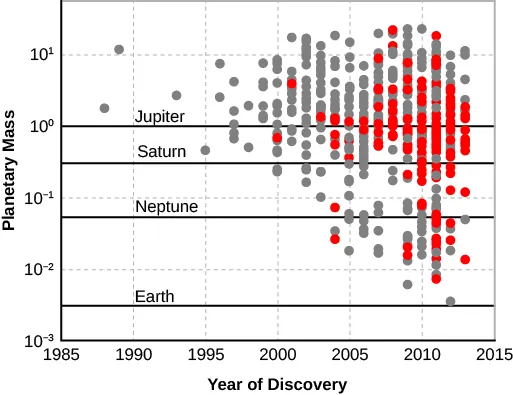
selection effect
Definition: A systematic difference between the population observed and the population that exists, caused by how targets enter a sample.
Why it matters here: It can create false trends or hide real populations even when every measurement is individually accurate.
Relationships: Detection threshold, survey cadence, wavelength, geometry, and follow-up choices define a selection function.
Boundary or common confusion: It is not random noise and cannot always be removed by increasing sample size.
transit
Definition: A periodic decrease in observed stellar flux when an orbiting body crosses the star's apparent disk.
Why it matters here: Transit depth estimates planet-to-star area ratio and repeated timing determines orbital period.
Relationships: For a small dark planet, \(\Delta F/F\approx(R_p/R_\star)^2\); spectroscopy during transit can probe an atmosphere.
Boundary or common confusion: Only favorably aligned systems transit, and stellar variability or blended eclipsing binaries can mimic the signal.
\[ \frac{\Delta F}{F}\approx\left(\frac{R_p}{R_\star}\right)^2 \]
radial velocity
Definition: The component of an object's velocity along the observer's line of sight, inferred from Doppler shifts.
Why it matters here: Periodic stellar radial-velocity changes reveal the gravitational pull of orbiting companions.
Relationships: Combined with a transit, it constrains planet mass and density; the signal also depends on orbital inclination.
Boundary or common confusion: Without inclination information it usually yields a minimum companion mass, and stellar activity can imitate a planet.
multi-messenger astronomy
Definition: The coordinated study of an event or source using different carriers such as electromagnetic radiation, gravitational waves, neutrinos, and cosmic rays.
Why it matters here: Different messengers probe complementary regions and physical processes that one channel alone cannot reveal.
Relationships: Timing and sky localization link detections; physical models must explain all messenger data consistently.
Boundary or common confusion: Coincidence is not automatically association, and each messenger has distinct backgrounds and localization limits.
biosignature
Definition: An observable feature whose presence, abundance, pattern, or disequilibrium could indicate biological activity.
Why it matters here: It frames the search for life as inference from measurements rather than recognition of a single Earth-like molecule.
Relationships: Atmospheric spectra, surface reflectance, environmental context, and planetary evolution all enter interpretation.
Boundary or common confusion: No proposed biosignature is automatically proof of life; abiotic false positives and biological false negatives must be tested.
uncertainty
Definition: A quantified statement of the range and structure of values consistent with measurement and model limitations.
Why it matters here: It determines how strongly data support a claim and whether two results are meaningfully different.
Relationships: Random noise, calibration systematics, model assumptions, and sample variance contribute in different ways.
Boundary or common confusion: Uncertainty is not ignorance or error in the sense of a mistake, and a narrow statistical interval does not include every systematic risk.
source evaluation
Definition: The structured assessment of a claim's provenance, evidence, methods, expertise, conflicts, and consistency with independent results.
Why it matters here: It separates persuasive presentation from reliable astronomical knowledge.
Relationships: Primary data, peer-reviewed analysis, mission documentation, uncertainty, and reproducibility form an evidence chain.
Boundary or common confusion: Authority alone does not prove a claim, while a single anomaly does not overturn a well-tested model without comparable evidence.